For All
In care of Thee Dearest Lynnie
A time to reflect. Of looking; to sometimes see. A clear sound, and
of where it comes. A time of choice. A wish for newness. A lingering
hope for delight. A year or so ago I remember my self dashing beyond
any attempt at a carefully placed step. All was glory. I was the self
drempt prince. Today now, a different sort of time comes into me.
Still there is the bounding feeling of the heart demanding the feeling
of vision, but its power is as the weight of the long runner, and not
the feeling of the man skipping with the stones he lightly kicks to the
sky, to the fence post, or gladly in his manhood tosses away to the
distance a sight of strength for his lover. It is a pressing time. Very
large. Large enough to fill weight.
There will be a depression. I can feel it here ahead of the city listeners.
There is a beginning here, but with it there is an end, and with the
end, another beginning. To begin ahead of the ending is the point. Shortly,
all people captivate by an emotional vision of the period, and the
realization that the sober classical approach is a beginning key of
possibility for the acknowledgement of their destany, will let all else
(thought) fall to the sensation telling experience, that unity with other
spirits inclined to the same line, direction, or subject matter as theirs,
is. the only now completeness left with even a temperary embrace of
humanity in spirtiual movement in this world (if it happens) without
Amen.
Love Jack
To Whom it may Concern:
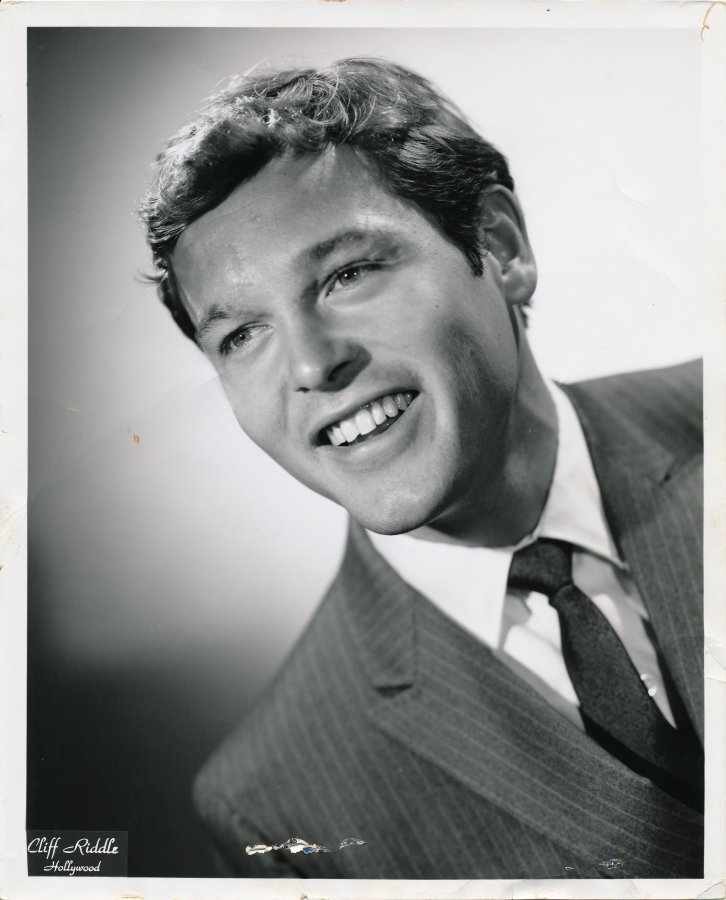
I was born in Los Angeles, California and moved to Pittsburgh,
Pennsylvania at the age of four. My father was transferred as a
distributor by Wurlitzer Music Company, and our family went on
to prosper as I attended Saint Bernard's Jesuit for eight years,
Valley Forge Military School in the summers, and Mount Lebanon
Public High-school from where I graduated in 1959. During 1957,
1958, and 1959 I also worked for my father as a dock man in
shipping & receiving and as a collector for approximately four
months out of each year. I was co-captain of Saint Bernard's
football and basketball teams, and was awarded a scholarship
in sports to Valley Forge where I also studied Judo with the
internationally recognized instructor Colonel Flories, but franke-
ly I was more drawn to my father's business during my later years
of high-school. And after high-school I went to work full time
for my father whose office and warehouse (Music Distributing Com-
pany, 2001 Fifth Ave., Pittsburgh, Pa. 15219) bordered the mer-
chant European Ghetto, Black Neighborhoods, and University Dis-
trict. After returning from a business trip to the Caribbean and
South America with my father in 1960, I entered night school at
the Pittsburgh Playhouse for the study of theatre. Early in 1961
I was offered a job with a professional touring company: (The Pitts-
burgh Children's Theatre) under the direction of Fay Parker doing
Children's Classics over a five state area. I took the job; con-
sequently leaving the employ of my father.
In June of 1962 I left the Children's Theatre to go to work
at the Seattle World's Fair as a "Barker" on the Midway. From
there I was hired out of San Francisco to work the slot machine
banks at Harrahs' Club in Lake Tahoe. However in the spring of
1963 I left Lake Tahoe for Alaska, where I got a job at Columbia
Ward's Fisheries in Kenia, Route # 2. The work was with seasonal
Salmon, but it was good work as an assistant on the "Retorts",
or canning boilers. For four months I worked long responsible
hours, ate, slept, and read books. Although I had accumulated
approximently $5,000 since graduating from high-school, I hitch-
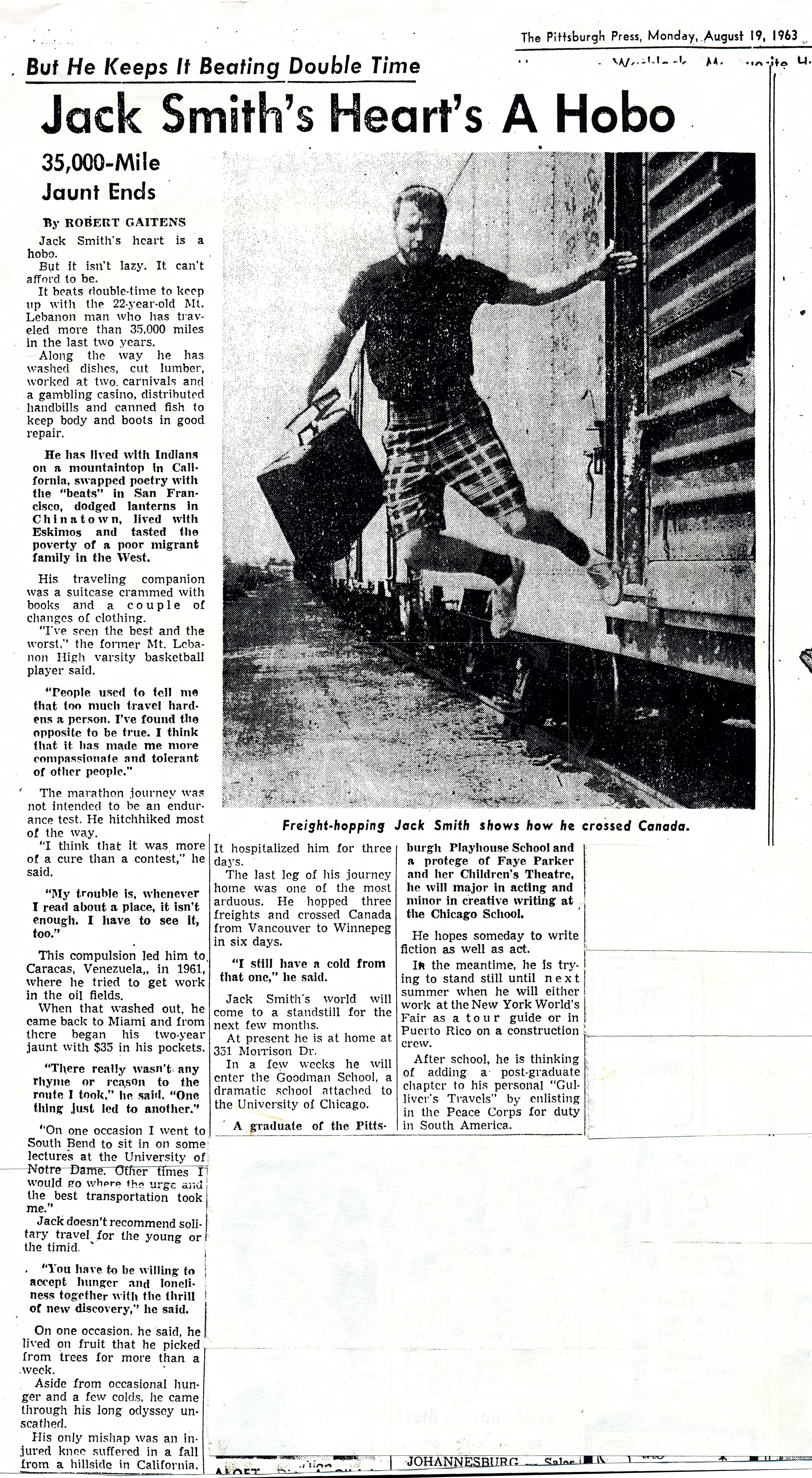
hiked and hopped freight trains back from Alaska across Canada
to Proviencetown, Mass. Returning to Pittsburgh, I did a twenty
minute interview spot on Pittsburgh's television statiom Channel
2 about that experience. It was the fall of 1963, and from there
I enrolled for further study in Chicago's Goodman Theatre. Though
realizing the good fortune to be studying under the Russian dir-
ector Madam Leonavich and the American author George McGraw, after
one semester I left the Goodman Theatre for New York. I went to off
and on Broadway plays every day for six weeks; but I decided that I
did not want to hunt for work in that world, and instead went dir-
ectly across the United States to Mexico. After three months of
traveling a great deal in Mexico I got a job in April of 1964 with
the Australian Merchant Mariner's on the ship Trangie out of Sidney
at the Port of Manzanillo. I was one of eight stockmen hired on to
rid the ship of 4,000 dead sheep before the first stop back arrival
at Suva, Fiji where I got off because of mutiny and illness.
I spent May and June of 1964 in Fiji in convalescence and as a
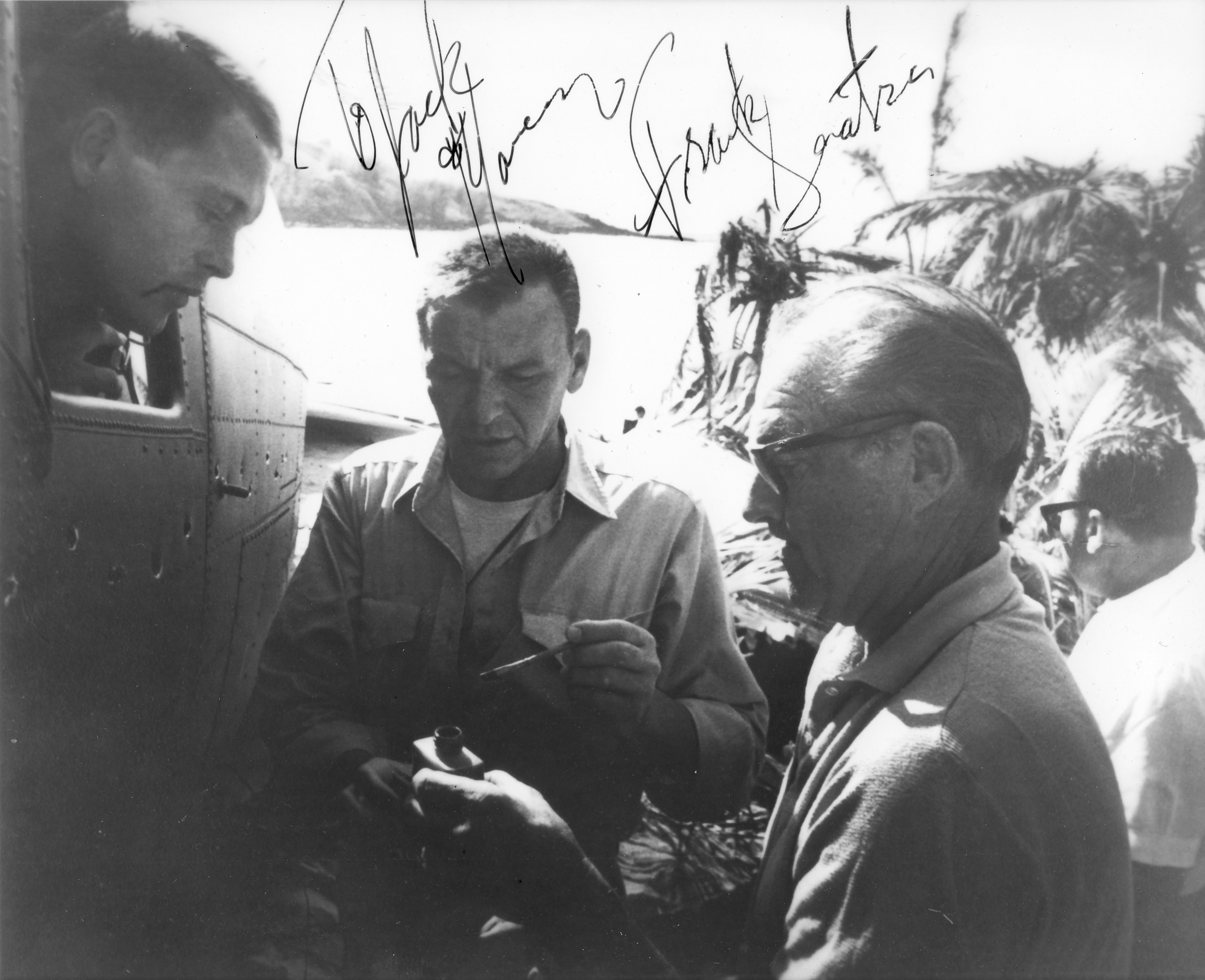
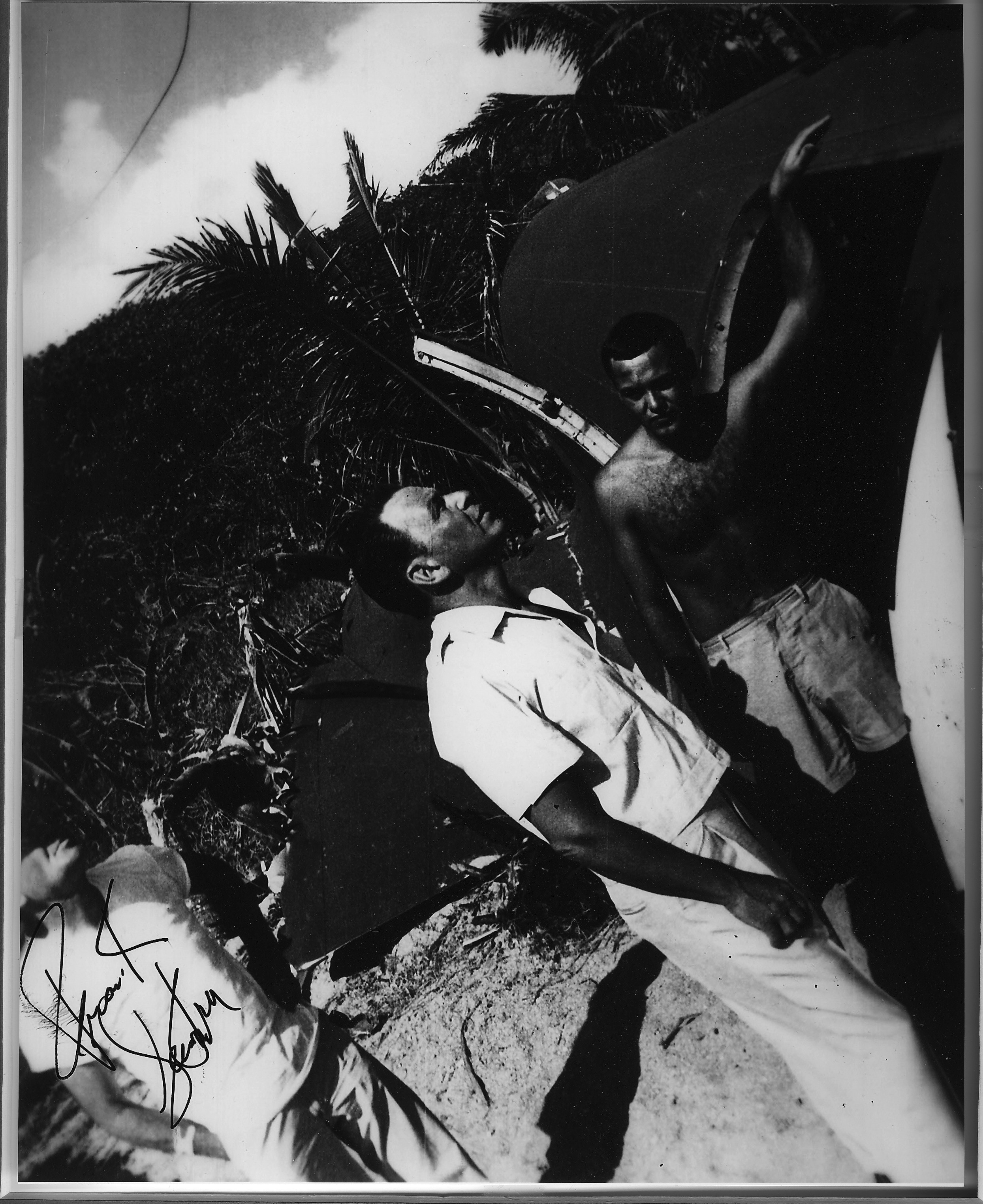
tourist, and got a lead on a job for Frank Sinatra. I flew to
Hawaii and got the job on the Island of Kauai working with "None
But the Brave" for four months. After my work was finished I went
with a letter of employment referral from Frank Sinatra and his
corporation business manager Howard Koach to Otto Preminiger and
was put fourth in line for an interview. I waited for six weeks
in Honolulu for a phone call, and at that point went to the Hono-
lulu Yacht House and got a job on a sailing ship with an eleven
man crew. We were three weeks out before coming into Saint Francis
Harbor in San Francisco. I spent the late fall of 1964 washing dishes,
cooking breakfast and tending bar at Big Sur Hot Springs, California.
During the early winter months I did odd jobs at a sky resort on
Mount Crystal, Washington and during January and Feburary of 1965
I worked as a parking attendant for System's Corp. in Beveraly Hills,
Calif. In March of 1965 I went to work with Pittsburgh's Office of
Economic Opportunity full time as an acting teacher until June of
1966 with Father Patrick Jones and Mr. Bernard Powers centered at
Pittsburgh's Epiphany Church in Washington Square 15219, I went back
to work with System's Corp. in Hollywood during the remainder of 1966,
and then went to work as a stage grip for Allied Artist's Movie Studio
through 1967 up until the Fall of 1968. During this time I also wrote
a script that was discussed by Cory Allen of Universal, Garry Michael
White of United Artist's, and Jack Lemmon, but it was not produced. On
the date 9/4/68 I got a U.S. Merchant Mariner's Document through a
letter of commitment from Diamond Williams Shipping in San Pedro, Ca.
The San Pedro Union Hall referred me to San Francisco because
that harbor was sending alot of chemical and arms ships to Viet-
nam, but after six weeks in the San Francisco Union Hall I be-
came discouraged deciding to go to Seattle where grain ships were
going to India. However accident had it that I was offered a job
working with emotionally distrubed children both at the Clearwater
Ranch and the Ashiku Institute in Philo, California in late Nov.
of 1968, and so I went to work there until Nov. of 1969, during
which time I also drafted a novel and a collection of poetry. The
novel deals with my own childhood as a counterpoint to the children
I was working with at that time. The poetry I now believe reflects
the psychology of Carl Jung which was being expressed at the Ashiku
Institute by the Albanian and Swiss directors there. I had been ex-
posed to Gestalt Psychology through Doctor Fritz Peirls at Big Sur
Hot Springs, but that had been a brief experience. With seminar be-
ing a constant part of the program at the Clearwater Ranch and the
Ashiku Institute, it was a very educational years.
During the years of 1970, 71, 72, 73, and 1974 I lived in Western
Oregon leasing five acres of land and a large historic farm house
from Mrs. Margaret Hull of Monroe, Ore. 97456. Work over this period
of time includes one year at the Frank Cambell Farm, Wickwire Lane,
Junction City, as an organic fruit and vegetable grower. One year
with Jack and Sally Woverton at the Monroe Meat Service, Monroe, Ore.
97456, as a meat cutter. Approximently two years between Hull—Oaks
and the I.P. Miller lumber mills as a grean chain puller, boiler man,
and night (key-punch) watchmen. Both mills receive mail at the Monroe
post office 97456, and can be reached by phone through the
Bellfountain exchange. For approximently one more year I
managed the inventory at the K.&D. Market on Main Street in
Monroe, built two barns, and was a handy-man for the Monroe
Water Company. Also embraced in these five years; a large and
productive garden, the function of a large farm house dependent
on wood for heating and cooking, and the general responsibility
of land control in a small town. With this I drafted a second
large novel dealing with past experiences in Los Angeles, and
another collection of poetry dealing with country life.
Toward the end of 1974 my father had a heart attack, and I
returned to Pittsburgh immediately going to work in the steel
mills for C.G. Hodder Refactory Brick Constructiom Company,
Washington Bulvd,, Bridgeville, Pennsylvania. I worked as a
laborer for them for six months, and in June of 1975 went to
work as a "nozzleman" for Sofis Construction Company out of Beaver
County, Pennsylvania "shooting" Basic Oxygen Furnace Vats at
J.&L's largest mill on the Ohio River. I worked with them until
Feb. of 1976 when I went to work on the Ohio River boats as a
Merchant Mariner with Dravo Corp. hauling coal and gravel until
Oct. 1976 when I went to work with Iron Workers on bridges em-
ployed by Mellon Stuart Company, 1425 Beaver Avenue, Pittsburgh,
Pennsylvania 15233, until Sept. of 1977. At this time I went back
to work with my father at Music Distrubiting Company, 2001, Fifth
Ave. until returning to Oregon in January of 1979. While with my
father I also completed a sixth book put into a poetry manuscript.
After leaving Pittsburgh in Jan. 1979, my wife and I
and our two children traveled for three months taking
in a large part of the Pacific Northwest finally rent-
ing a log cabin on the Willimatte River outside of
Eugene, Oregon, where I worked jobs in construction,
in lumber mills, in house painting, and restraunts,
all the while continuing to draft more work in liter-
ature until returning to Pittsburgh in late Aug. 1980.
Since that time I have been looking for work while
collecting a Welfare Disability Grant for a split
Achilles Tendon.
My main desire is to return to the creative work
world.
He was told he was a bastard when he was four and he wrote
this when he was twenty six because he remembered that Gurtuide
Stien had once said that everybody was twenty six. But it all
would change, that is turn around on him, so that he clinged
and sought the distance of all things close, because he would
at the brink of the american abyss understand the way of his
birth of this wild hearted yet damaged spirited land.
GPT
This resume moves through work history, ambition, emotional force, and self-definition, turning a practical document into a portrait of how Jack understood his own life.
It belongs with the other manuscript documents because even in resume form it keeps bending practical record toward vision, declaration, and self-explanation.
Claude
A nine-page resume that keeps turning a practical document into self-mythology. Behind the 'To Whom it may Concern' frame, it lays out a real and improbable life: a Los Angeles birth, a move at four to Pittsburgh, Jesuit and military schooling, then theatre study and an adventurer's ledger of fairs, fisheries, freight travel, and Mexico. The middle pages read as relentless hustle, including a Frank Sinatra film job on Kauai, Big Sur, anti-poverty work, work with emotionally disturbed children, Oregon farm and mill labor, and a return to Pittsburgh steel and the river. The document opens with a dedication 'For All' that forecasts 'a depression' and hopes for 'the Only new completeness left', and closes in the third person on bastardhood and 'the american abyss.' Even in resume form, the writing bends practical record toward vision and declaration.
The resume is valuable because it cross-references the rest of the archive in documentary register, confirming that the poems' settings are lived biography rather than invention. But the author cannot stay inside the genre. The opening dedication and the third-person closing coda convert a job application into a manifesto about damage and creative destiny, evidence that for this writer no mode escaped the moral intensity that drives the poems.